Smart Casual Dressing Guide: Seamless Transitions from Office to Evening
Master the art of smart casual dressing with versatile pieces that carry you from the boardroom to dinner without missing a beat. Practical advice for the modern man.
Understanding Smart Casual
Smart casual has become the most frequently requested dress code in modern life, yet it remains the most widely misunderstood. The term appears on dinner invitations, conference agendas, and client meeting briefs, leaving men staring into their closets with genuine uncertainty. The confusion stems from the inherent contradiction at the heart of the concept. Smart casual asks you to be formal enough to signal respect for the occasion while remaining relaxed enough to appear approachable and modern. It is not a specific uniform but a spectrum of possibilities bounded by clear rules about what belongs on each end. Understanding where your specific event falls on that spectrum is the first step to mastering smart casual dressing.
The foundational principle of smart casual is intentional contrast. A blazer paired with jeans is the classic expression of this idea. The jacket provides structure and formality while the denim introduces ease and familiarity. The same principle applies to textures, colors, and accessories. A smooth worsted wool tie looks out of place with a chambray shirt, but a knitted silk or wool tie complements it perfectly. The contrast must appear deliberate rather than accidental. This is what separates the effortlessly well-dressed from those who look like they simply grabbed whatever was clean. Every element of the outfit should communicate a choice, even if that choice is to keep things simple. The absence of a tie, for example, is a choice that must be supported by the rest of the outfit. An open collar only works if the shirt has a collar that stands up properly and the jacket lapels lie flat.
The blazer is the cornerstone of any smart casual wardrobe. Unlike a suit jacket, which is designed to be worn exclusively with its matching trousers, a blazer is a standalone piece built for mixing. The navy blazer in particular is the most versatile garment in men's fashion, capable of pairing with gray wool trousers for a business-appropriate look, khakis for a standard smart casual appearance, or dark jeans for a relaxed evening outing. The fabric of the blazer determines its range. A smooth, shiny fabric like tropical worsted reads as formal and limits the blazer's mixing potential. A textured fabric like hopsack, flannel, or tweed has inherent casual character that blends seamlessly with a wider range of separates. Patch pockets, contrasting buttons, and unconstructed shoulders all push a blazer toward the casual end of the spectrum, increasing its versatility for smart casual applications.
Essential Wardrobe Pieces
Trousers in the smart casual wardrobe require the same careful consideration. The old rule that jeans are never appropriate for anything beyond weekend errands has been thoroughly retired. Dark wash jeans without rips, fading, or distressing now occupy a legitimate place in smart casual dressing. The key is the condition and cut of the jeans. They must be clean, pressed, and free of any embellishment. The cut should be straight or slim but not skinny, with a length that breaks cleanly over the shoe. Similarly, chinos have evolved from purely casual wear to a smart casual staple. The difference between a chino that reads as sloppy and one that reads as intentional often comes down to the crease. A chino with a sharp front crease, achieved through pressing or the fabric's natural memory, crosses the line into smart territory without losing its casual foundation.
Footwear anchors the entire smart casual outfit and communicates more about your intent than any other element. The wrong shoes can destroy an otherwise perfect ensemble. The smart casual shoe spectrum runs from loafers at the formal end to clean minimalist sneakers at the relaxed end. Penny loafers, tassel loafers, and horsebit loafers in leather all work well with tailored trousers and dark jeans. The leather should be polished but not mirror-shined, signaling care without formality. Suede loafers or chukka boots offer a middle ground that works across a wide range of outfits and occasions. At the casual end of the smart casual spectrum, minimalist white leather sneakers in excellent condition have become universally acceptable. The critical distinction is between sneakers that look intentional and sneakers that look like athletic footwear. Any visible branding, thick soles, or mesh panels immediately disqualify a sneaker from smart casual use.
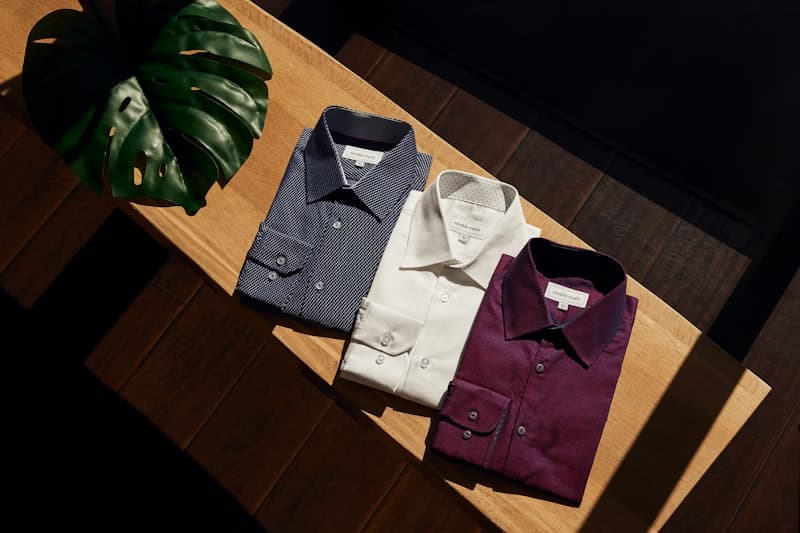
The shirt is the element that most directly controls the formality level of a smart casual outfit. An Oxford cloth button-down worn without a tie and with the top button undone represents the standard smart casual shirt. The button-down collar, originally designed for polo players to keep their collars from flapping, has a inherent casual quality that makes it ideal for unbuttoned wear. A spread collar or point collar shirt worn without a tie can look incomplete unless the collar has sufficient structure to stand on its own. This is where collar stays become essential. Without stays, even a quality shirt collar will curl and droop, creating a sloppy appearance that undermines the entire outfit. The fit of the shirt matters enormously in smart casual contexts because the absence of a tie exposes the neckline and chest area to direct scrutiny. A shirt that gaps at the buttons or billows at the waist reads as careless rather than intentionally relaxed.
Layering and Accessories
Layering is the smart casual dresser's most powerful tool for managing transitions between settings. The three-layer system of shirt, sweater or vest, and jacket allows for adjustments throughout the day. A man who starts his morning in a client meeting with a blazer and dress shirt can remove the blazer, roll his sleeves, and appear appropriately relaxed for an evening dinner. The sweater layer, whether a merino wool crewneck, a cashmere V-neck, or a cardigan, provides insulation and structure that fills the gap between shirt and jacket. The texture of a knitted garment introduces the contrast that smart casual requires. A smooth cotton shirt under a textured wool sweater under a smooth cotton blazer creates a play of surfaces that reads as sophisticated without being fussy. The colors should follow a clear logic, typically starting with the darkest shade on the outside and lightening toward the body.
Accessories in smart casual dressing follow the same principle of intentional contrast. A leather watch with a metal bracelet reads as dressy, while the same watch on a rubber or NATO strap swings casual. The belt should match the shoes in both color and finish, but this rule relaxes slightly in smart casual contexts where a suede belt with leather shoes or vice versa can work if the colors harmonize. Pocket squares are optional in smart casual but highly effective when used correctly. A linen white pocket square in a simple puff fold adds a touch of deliberate polish without the formality of a silk square. The goal of accessories in smart casual is to show that attention has been paid without suggesting that too much time was spent. A single thoughtful accessory, whether a distinctive watch, a quality bracelet, or well-chosen eyeglasses, achieves this balance more effectively than multiple competing pieces.
The evening transition is where smart casual truly proves its value. The same foundation of blazer, shirt, and trousers that served for the workday can shift into evening mode through small adjustments. Unbuttoning the jacket, rolling the shirt sleeves once or twice above the wrist, and loosening the collar transforms the outfit's energy without a complete change of clothes. The evening version should read as relaxed but not diminished, as if the wearer is equally comfortable in both settings.
Mastering Color, Fit, and Seasonal Dressing
Color coordination across the smart casual wardrobe requires a systematic approach. A useful framework is the three-zone system where the jacket, trousers, and shirt each occupy a distinct role. The jacket provides the dominant color and sets the tone. The trousers should be in a complementary but distinct color, typically lighter for daytime and darker for evening. The shirt serves as the transition piece, bridging the two with a color that works with both. Neutral colors such as navy, gray, khaki, and white form the backbone of this system because they are fundamentally compatible. Once the neutral foundation is established, accent colors can be introduced through accessories such as pocket squares, ties, and shoes. A navy blazer, gray trousers, and white shirt with brown shoes and a burgundy pocket square is a foolproof combination that works from a casual Friday at the office through dinner at a mid-range restaurant.
The importance of fit in smart casual dressing cannot be overstated. Because the dress code involves mixing pieces from different formality levels, any misfit stands out more dramatically than in a uniform. A blazer that is too tight or too loose will look conspicuously wrong against well-fitted jeans. Trousers that are too long will pool over the shoes and undermine the intentional look of the outfit. The standards of fit that apply to formal wear apply equally to smart casual, with the added complication that different fabric weights and constructions may fit differently even at the same labeled size. A structured jacket in wool will fit differently from an unstructured jacket in cotton, and both should be evaluated on their own terms rather than assumed to fit the same. The man who masters fit in smart casual has solved the hardest part of the equation.
Seasonal considerations in smart casual dressing add another layer of complexity. Summer smart casual favors lighter fabrics and a more relaxed silhouette. A linen blazer worn with cotton chinos and suede loafers creates a warm-weather smart casual look that is both appropriate and comfortable. The absence of a tie is expected in summer, and the open collar should show just enough of the chest to read as relaxed without crossing into beachwear territory. Winter smart casual embraces heavier textures and deeper colors. A tweed jacket with dark flannel trousers and a merino turtleneck creates a cold-weather smart casual look that is both warm and polished. The turtleneck replaces the shirt and tie combination while maintaining the structure that the dress code requires. Layering becomes more complex in winter but also more rewarding, as each layer adds visual interest and the opportunity for texture contrast.
Building Your Smart Casual Wardrobe
Building a smart casual wardrobe from scratch does not require a large budget or a complete closet overhaul. Five foundational pieces can create dozens of outfits when chosen carefully. A navy blazer in a textured fabric, a pair of dark wash jeans, a pair of gray wool trousers, a white Oxford cloth button-down shirt, and a pair of brown leather loafers form the core of a smart casual wardrobe that covers most situations. From this foundation, additions can be made based on specific needs. A second blazer in a different color or fabric, a pair of chinos, a knitted tie, and a casual jacket such as a field coat or chore jacket expand the range of combinations exponentially. The key is choosing each piece with the entire system in mind, ensuring that colors, textures, and formality levels harmonize rather than clash.
This seamlessness is the ultimate achievement of smart casual dressing. It signals that the wearer understands context and can navigate different social environments with the same fundamental toolkit. The confidence that comes from knowing your outfit works everywhere in your evening allows you to focus on the people and the occasion rather than worrying about whether you are appropriately dressed.