The Minimalist's Guide to Men's Wardrobe Essentials
Build a capsule wardrobe with fewer, better pieces. Expert advice on quality suiting, neutral palettes, and investment pieces from brands that prioritise craftsmanship.
The Philosophy of Minimalist Dressing
Minimalist fashion is not about deprivation — it is about intentionality. Every piece in a minimalist wardrobe must earn its place by being versatile, well-constructed, and timeless in design. The goal is to own fewer items of higher quality, each capable of multiple functions and combinations. For the modern man, this means beginning with foundation pieces that form the core of a working wardrobe: exceptional suits, shirts, knitwear, and footwear in neutral tones that work together seamlessly. The minimalist approach saves money over time, eliminates decision fatigue, and projects a quiet confidence that loud branding or trend-following can never achieve. Brands like Brunello Cucinelli, Loro Piana, and The Row epitomise this philosophy, though more accessible options like Cos, Arket, and Suitsupply offer quality minimalist pieces at lower price points ranging from $100 to $800 per item.
Building the Capsule Suit Collection
A minimalist wardrobe needs no more than three suits, each chosen for maximum versatility. Start with a mid-grey wool suit in a lightweight fabric, around 9 to 10 ounces, from a maker like Suitsupply's Jort line or Spier & MacKay. This single suit, priced between $400 and $800, can be dressed up with a white shirt and dark tie or dressed down with a merino rollneck and sneakers. The second suit should be navy — not corporate navy, but a slightly textured version in wool-mohair or a wool-silk blend. Ring Jacket's signature navy suit at approximately $1,200 offers a soft shoulder construction that works for every occasion. The third is a personal choice: either a charcoal flannel for winter depth or a light beige cotton-linen blend for summer ease. Each suit should be purchased with the understanding that it will be worn regularly for years, not seasons. Alterations matter enormously — a $500 suit that is perfectly altered will look better than a $3,000 suit off the rack.
Shirts, Knitwear, and the Layering System
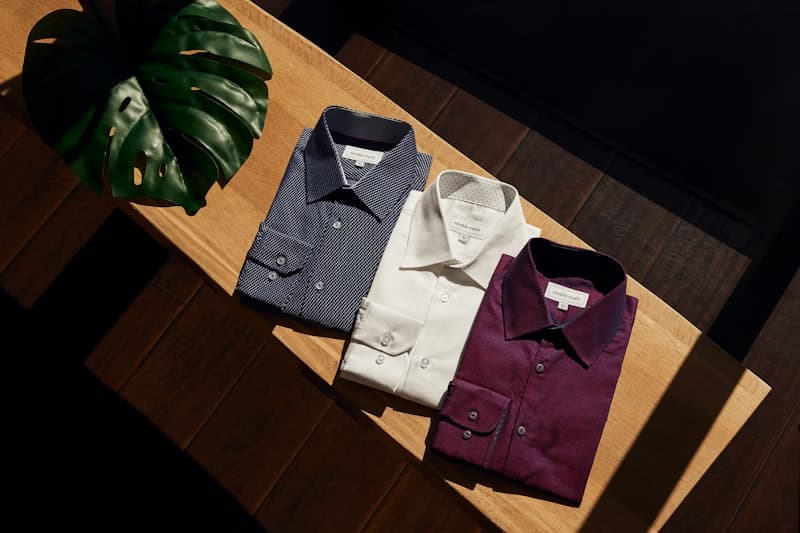
The minimalist shirt collection needs only five pieces: two white oxford cloth button-downs from Kamakura or Mercer & Sons ($80 to $150 each), one light blue in the same style, one cream or ecru linen shirt for summer, and one fine-gauge grey merino crewneck that doubles as a shirt alternative. Knitwear forms the heart of minimalist layering. A navy merino crewneck, a charcoal cashmere rollneck, and a brown lambswool cardigan provide year-round coverage. Brands like John Smedley, Inis Meain, and William Lockie produce exceptional knitwear at $150 to $400 per piece. The colours should all be mutual — navy, grey, cream, brown, and olive — so that any top pairs with any bottom. Avoid patterns beyond simple stripes or subtle textures. The texture itself — the difference between a smooth merino, a nubby lambswool, and a soft cashmere — provides all the visual interest a minimalist wardrobe needs.
Outerwear and the Finishing Layer
Outerwear in a minimalist wardrobe must withstand varied weather while complementing everything underneath. A single tailored overcoat in charcoal or camel hair from Private White V.C. or Mackintosh serves as the primary cold-weather piece, priced between $800 and $1,800. Its silhouette should be straight and slightly oversized to layer over suits and knitwear alike. A waxed cotton field jacket from Barbour in olive or navy adds rugged, weather-proof versatility for casual days at $300 to $500. For transitional weather, a suede bomber jacket or a lightweight cotton mac from Valstar or Burberry provides the missing link between tailored and casual. The rule is simple: each outer layer must be able to be worn over any outfit in the wardrobe, from a full suit to jeans and a t-shirt. This interdependence is the secret to minimalism — every piece works with every other piece.
Footwear and Accessories With Purpose
Footwear follows the same minimalist principles: fewer pairs, higher quality, greater versatility. Four pairs suffice for most men: a dark brown derby shoe from Crockett & Jones or Edward Green ($500 to $1,000), a black captoe oxford from the same makers for formal occasions, a pair of suede chukka boots from Sanders or Tricker's ($400 to $600), and white minimalist leather sneakers from Common Projects or Axel Arigato ($300 to $500). Each pair should be resoleable — Goodyear welted construction allows this — extending the life of the shoes to decades rather than years. Accessories should be similarly edited: one quality leather belt that matches the primary shoe colour, one simple watch on a leather strap (a Junghans Max Bill or Nomos Orion at $800 to $2,000), and one weather-appropriate scarf, either silk for spring or cashmere for winter. A minimalist wardrobe is not about having nothing — it is about having exactly what you need and nothing more.