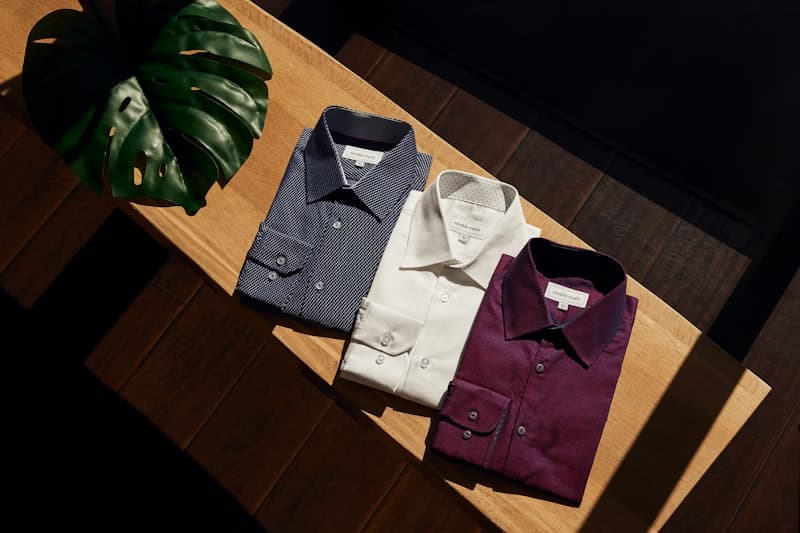
Elevated Business Casual for Men: Where Comfort Meets Refinement
Introduction: The Biggest Misunderstanding
"Business casual is just a suit without a tie, right?"
If this describes your understanding, you're in good company—and also wrong. Business casual is not "formal wear minus one element." It is a distinct dress code with its own vocabulary of garments, its own color logic, and its own social signals.
LinkedIn's 2025 Global Workplace Dress Survey found that 73% of tech companies and 62% of fintech firms now designate business casual as their primary dress code. Yet 43% of employees at these companies admitted they were "unsure" whether their daily outfit met the standard. The most common errors fall into two camps: dressing like you're headed to the golf course (too casual), or dressing like a banker who was told to "loosen up" (too stiff).
This guide bridges that gap.
1. The Business Casual Garment Library
1.1 Tops
Core:
- Two sports jackets: One navy (solid or with subtle texture), one in a lighter neutral (tweed, herringbone, or glen plaid). A sports jacket differs from a suit jacket in its texture, buttons (brass or horn), and frequent patch pockets.
- One blazer: Navy with metal buttons. This sits between a sports jacket and a full suit in formality.
- Two merino wool sweaters: Crewneck or V-neck in charcoal and navy. Can be worn alone or layered over a shirt.
Optional:
- A suede or shearling jacket for textured layering
- A dark denim jacket (creative fields only)
1.2 Bottoms
The fabric and construction of your trousers define the formality of the entire outfit:
- Worsted wool trousers: The safest choice. Preserves a sharp silhouette and reads as intentional.
- Chinos: The workhorse of business casual. Choose flat-front, mid-rise, straight-leg cuts in khaki, olive, or navy.
- Dark raw denim: Acceptable only when dark, unwashed or minimally washed, with no rips or fraying. Pair with a sports jacket, never a blazer.
Avoid: Cargo pants, shorts (any kind), heavily distressed denim, joggers, or any trouser with an elastic ankle cuff.
1.3 Footwear
| Shoe | Formality | Recommended Colors | Best With |
|---|---|---|---|
| Derby shoe | Medium-high | Dark brown, oxblood, black | The default business casual shoe. Works with wool trousers and chinos. |
| Loafers | Medium | Tan, dark brown, black | Summer first choice. Wear without socks or with no-shows. |
| Chelsea boots | Medium | Dark brown, black | Autumn/winter. Pair with wool trousers or dark denim. |
| White-soled derby | Low-medium | Brown | Creative offices, casual Fridays only. |
| Minimalist white sneaker | Low | White | The outer limit of acceptable. Keep them immaculate. |
2. Color Systems: Three Formulas That Work Every Time
Rather than deciding color combinations from scratch each morning, use these three proven formulas:
Formula 1: Navy + Brown (Most Versatile)
- Navy sports jacket + khaki chinos + dark brown derbies + white or light blue shirt
- Variation: Swap the jacket for a navy merino crewneck on warmer days; add a neutral topcoat in cooler weather.
Formula 2: Gray + Navy (Safest)
- Mid-gray wool trousers + navy blazer + black or dark brown loafers + light blue oxford shirt
- This is the "default setting" of business casual—reliable, professional, and unremarkable in the best sense.
Formula 3: Earth Tones (Most Sophisticated)
- Taupe sports jacket + olive chinos + snuff suede derbies + white oxford shirt
- Earth tones (beige, khaki, olive, taupe, brown) naturally harmonize. You cannot fail with this palette.
Advanced move: Use socks as an accent. A burgundy or dark green argyle sock can become the visual anchor of an otherwise neutral outfit. But only if everything else is restrained.
3. Situational Strategy: Dress for the Room You're Walking Into
The hardest part of business casual is its elasticity—the same term means different things in different companies, meetings, and industries.
Scenario A: General Office Day
- Goal: Clean, professional, unobtrusive
- Formula: Chinos + oxford shirt + derbies + optional merino sweater
- Avoid: Logo apparel of any kind, athletic sneakers, baseball caps
Scenario B: Client Meeting
- Goal: Signal that you take the meeting seriously
- Formula: Sports jacket + wool trousers + shirt + tie (optional but bring one—adjust based on what the client wears)
- Key principle: Dress half a step above the client. If they're in t-shirts and jeans, wear a blazer with chinos. If they're in suits, wear a suit.
Scenario C: Internal Interview or Promotion Panel
- Goal: Demonstrate you value the opportunity
- Formula: Full suit without tie, or blazer + formal wool trousers
- Mistake to avoid: Underdressing communicates "I didn't think this was important."
Scenario D: Casual Friday
- Goal: Relaxed but not sloppy
- Formula: Dark denim + sweater or oxford shirt + casual derbies or clean white sneakers
- Warning: Casual Friday is not track-pants-and-hoodie Friday. Maintain the structure, just loosen the formality.
4. Ten Business Casual Mistakes and How to Fix Them
- Chinos with athletic sneakers — The styles clash. If you wear chinos, wear shoes with some structure.
- Untucked shirt as default — Untucked works only with specific, shorter-cut shirts. If in doubt, tuck it in.
- Belt and shoes don't match — Brown belt with black shoes is the most common violation. Match leathers.
- Sports jacket with gym pants — Half your outfit says "meeting," the other half says "leg day."
- Polo collar popped — This fashion moment ended in approximately 2005.
- All buttons done up — The bottom button of any jacket stays undone, always.
- Bulging pockets — Phones, keys, and wallets destroy the line of any garment. Use a bag.
- Trouser break too long — Trousers pooling over your shoes looks sloppy. Aim for no break or a single subtle break.
- Overpowering fragrance — In an office, subtlety wins. Your cologne should be discovered, not announced.
- Visible logos — Business casual communicates taste through quality, not branding.
5. A Minimal Capsule Wardrobe
If you're building from zero, these seven items cover roughly 90% of business casual scenarios:
- Navy sports jacket (wool blend, half-lined)
- Light blue and white oxford cloth shirts (one each)
- Mid-gray wool trousers
- Khaki chinos
- Dark raw denim jeans
- Dark brown derby shoes
- Charcoal merino crewneck sweater
With these seven pieces, you can create at least 20 distinct outfits spanning the full range from Casual Friday to client presentation.
Conclusion
Elevated business casual isn't about dressing down. It's about drawing from a broader, more nuanced wardrobe to express the same professionalism.
The challenge—and the reward—is that without a uniform to hide behind, every outfit becomes a statement of personal taste. The goal is not to look like you tried too hard, and not to look like you stopped trying at all.
The sweet spot is this: your clothes should communicate "I am professional and I am comfortable in my own skin." That's the line worth finding.
Business Casual by Industry: Tailoring the Dress Code
One of the most important realizations about business casual is that it is not a monolith. The same outfit that signals professionalism at a creative agency may feel overdressed at a startup—or underdressed at a law firm. Understanding your industry's specific interpretation of business casual is essential to getting it right.
Tech and Startups
The tech industry has pushed business casual to its most relaxed extreme. Here, the code means "no hoodies, no distressed jeans, and no graphic tees." You can wear a sports jacket, but it is rarely required. The winning formula for tech is: a well-fitting merino sweater or a casual button-down (oxford cloth, chambray, or linen in summer) paired with dark denim or chinos. Shoes should be clean sneakers (leather or premium canvas) or suede boots. Blazers with metal buttons read as formal in this environment—stick to soft-shouldered sports jackets in textured fabrics like tweed or donegal wool.
Finance and Legal (Traditional)
In traditional professional services, business casual retains more structure than the name implies. "Casual" here means "no tie" rather than "no jacket." The baseline is a sports jacket or blazer with trousers—never jeans, never sneakers. A suit without a tie is also common, though be aware that many senior partners still interpret this as slightly underdressed. Stick to worsted wool trousers, dress shirts with spread or point collars, and leather derbies or oxfords. Sweaters are acceptable only when layered over a shirt and under a jacket—standing alone in a sweater reads as too casual for client-facing roles.
Creative and Advertising
Creative industries reward personal expression within the business casual framework. This is where you can experiment with pattern mixing, color, and texture in ways that would raise eyebrows elsewhere. A glen plaid sports jacket paired with olive chinos and a polo shirt reads as intentionally stylish rather than sloppy. Bold pocket squares, patterned socks, and statement watches are welcome. Just maintain one anchor of formality—if you wear jeans, keep the jacket structured. If you wear a colorful shirt, keep the trousers neutral.
Four Complete Head-to-Toe Business Casual Outfits
Theory is valuable, but execution is everything. Here are four complete outfits that demonstrate the principles in action, with specific garment recommendations you can replicate.
Outfit 1: The Safe Standard (Any Industry)
- Jacket: Navy wool blazer, brass buttons, notch lapel
- Shirt: Light blue oxford cloth button-down
- Trousers: Grey worsted wool flat-front
- Shoes: Dark brown derbies or bluchers
- Belt: Dark brown bridle leather, 1.25-inch width
- Watch: Silver dial on brown leather strap
- When to wear: Client meetings, interviews, any situation where you cannot afford to be wrong
Outfit 2: The Creative Professional
- Jacket: Brown herringbone tweed sports jacket, patch pockets, horn buttons
- Shirt: White pinpoint oxford, spread collar
- Trousers: Navy or olive chinos, flat-front, no break
- Shoes: Tan suede chukka boots or desert boots
- Belt: Weathered brown leather or woven leather
- Watch: Field watch on NATO strap or brown leather
- When to wear: Agency work, design reviews, casual Friday in traditional offices
Outfit 3: The Tech Founder (Polished Casual)
- Jacket: Optional—a charcoal merino crewneck sweater can serve as the topper
- Shirt: White or navy T-shirt (heavyweight, no visible logos)
- Trousers: Dark raw denim or charcoal wool trousers
- Shoes: Clean white leather sneakers (Common Projects, Axel Arigato, or similar)
- Watch: Minimalist stainless steel or black DLC
- When to wear: Startup office, pitch meetings, industry events
Outfit 4: The Warm-Weather Solution
- Jacket: Beige or light grey linen sports jacket
- Shirt: White or pale blue linen button-down (unbuttoned collar)
- Trousers: Stone or khaki cotton chinos
- Shoes: Brown suede penny loafers, worn sockless
- Belt: Straw or braided leather in natural tone
- Watch: Navy or white dial on tan leather or perlon strap
- When to wear: Summer client lunches, outdoor networking events, Southern offices year-round
The One-Item Upgrade Rule
If you currently own a basic business casual wardrobe (chinos, solid button-downs, a single jacket) and want to level up without spending a fortune, here is the single highest-impact purchase: a textured sports jacket in a neutral tone. A brown herringbone, a grey birdseye, or a navy hopsack blazer will transform your entire wardrobe because it creates contrast with everything you already own. A solid navy or charcoal jacket blends into the background and forces your shirt and trousers to do all the work. A textured jacket adds visual interest at the top of your silhouette—which is where people look first.