Style Guide for Bigger Body Types: Dressing Slimmer and Sharper
Dressing well when you carry extra weight isn't about hiding — it's about choosing the right cuts, colors, and fabrics that flatter your frame. Practical advice and specific brand recommendations.
Your Build Is Not the Problem — Your Clothes Are
Too many men with larger builds believe they can't dress well, so they don't try. This is the most expensive mistake you can make, and it has nothing to do with money. The truth is, bigger body types have a hidden advantage in clothing: you can fill out a garment in ways that slimmer men cannot. A well-tailored jacket looks powerful on a broad frame. A structured coat carries presence. The key is knowing which cuts, colors, and fabrics work for you — and which ones actively hurt you.
The single rule that governs everything in this guide: shift visual weight upward, and use structure instead of looseness to shape your silhouette. Three dimensions matter most — fit, color, and fabric — and each has its own traps.
The Right Fit: Close Without Clinging
The instinctive move when you carry extra weight is to buy a size up. Looser means more coverage, right? Wrong. An XL T-shirt doesn't hide your build — it amplifies it. The fabric drapes outward from your widest point, making everything look bigger. A 2XL hoodie turns you into a rectangle with no definition. Oversized clothing does not conceal size; it just blurs your shape into an undefined mass.
What you actually want is something harder than just sizing up or down: a fit that follows your body without squeezing it. Here's what to check on every garment:
- Shoulders: The seam should land exactly at the edge of your natural shoulder. Not hanging off. Not digging in. This single detail determines whether a jacket looks like it was made for you.
- Chest: Button the middle button of a shirt or jacket. There should be no horizontal pull lines across the chest. You should be able to pinch about 2-3 centimeters of fabric on either side.
- Waist: The garment should follow your torso without gripping it. A shirt should have enough room to tuck comfortably without fabric ballooning out.
- Sleeves: Cuff should hit the wrist bone. Not past the thumb. Not above the forearm.
A practical test: put on the garment, then raise both arms overhead and twist your torso. If the hem rides above your belt line, if buttons strain, or if the shoulder seam shifts dramatically — the fit is wrong.
Specific Recommendations by Garment Type
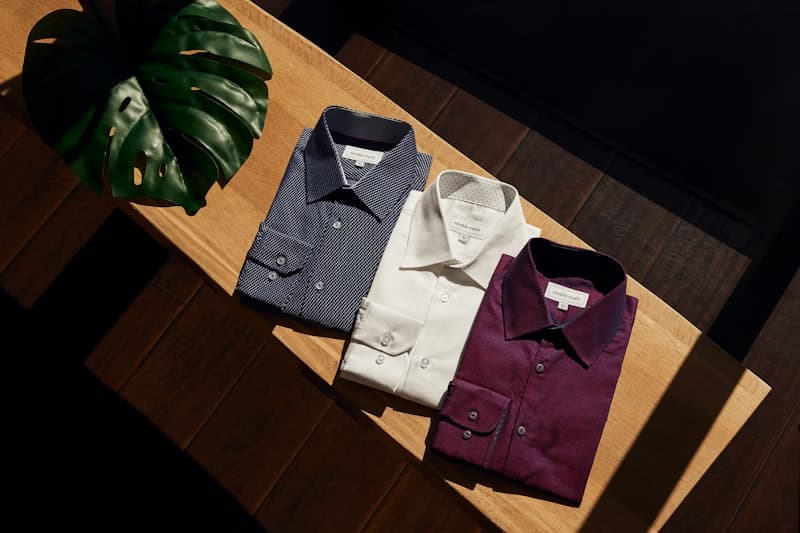
Shirts: Go for a regular or straight fit — never slim fit (which tapers at the waist) and never loose fit (which adds bulk). The Oxford cloth button-down from Uniqlo is a reliable entry point: not tailored, not baggy, just right for bigger frames.
Suits & Blazers: Single-breasted, two-button is your best friend. The two-button layout creates a natural V-shape at the chest when the top button is fastened. This V draws the eye up and in, away from the midsection. Leave the bottom button undone — that's not just style convention, it creates the visual opening you need. MUJI's unstructured blazers offer a relaxed-but-structured silhouette that works well.
Pants: Mid-rise or high-rise straight leg. Low-rise pants push your stomach over the belt line — the worst possible cut for a bigger frame. Straight leg keeps the silhouette vertical from hip to ankle. Uniqlo's Wide Straight Pants and Dickies 874 work pants are classics for a reason: their cut doesn't taper at the ankle.
Outerwear: H-cut (straight cut from shoulder to hem). Avoid anything cinched at the waist. A Carhartt WIP jacket or a classic trench coat in an H silhouette creates a clean vertical line that streamines your frame from shoulder to knee.
Color Strategy: Dark Foundation, Bright Accents
Dark colors create visual compression. This isn't a style opinion — it's physics. Light reflects off light colors and makes surfaces appear larger. Dark colors absorb light and make surfaces appear smaller. But dressing entirely in black is a missed opportunity: a solid black outfit looks flat and heavy rather than refined.
Instead, use a three-layer color system:
Foundation (60%): Navy, charcoal gray, deep brown, forest green. These are your workhorses. Navy has more depth than black and pairs with almost everything. Charcoal is softer than black but still contracts visually. Deep brown and forest green add personality without attracting unwanted attention.
Transition (30%): Light gray, off-white, khaki, oatmeal. These go between your dark outer layer and your face. A light gray sweater or cream-colored shirt breaks up the darkness and prevents your outfit from feeling like a single dark mass.
Accent (10%): Burgundy, mustard, patterned navy stripe. Use these in small doses — a tie, a pocket square, socks, or a scarf. The rule: keep accents above the waist. A burgundy scarf draws attention to your face, where it belongs. A bright belt or shoes draws attention to your midsection or feet.
Colors to Avoid
- Pure white in large blocks: Extremely expansive — a white suit or white pants will make you look significantly wider.
- Large patterns and loud prints: Patterns warp and distort over curved surfaces, drawing the eye to every bulge.
- Horizontal stripes: They widen visually. Vertical stripes are fine in moderation.
- Neon or high-visibility colors: They draw attention to exactly the areas you want to minimize.
Fabric: The Underrated Variable
Most men obsess over fit and color, then grab whatever fabric is cheapest. This is a mistake. The same shirt in a stiff cotton twill versus a stretchy microfiber will fit completely differently — even if the tag says the same size.
Fabrics that work:
- Cotton twill — has texture and holds its shape, doesn't cling
- Wool blends — drapes with weight and authority, the standard for suits and trousers
- Heavyweight cotton (250gsm+) — T-shirts made from heavy cotton don't cling to your body
- Denim — rigid enough to hold its shape, provides structure to the lower body
Fabrics to avoid:
- Microfiber, stretch cotton, or anything with high spandex content — they hug every curve
- Silk or rayon — too drapey, outlines the body rather than shaping it
- Thin-knit ribbed fabrics — they conform to body shape like a second skin
- Sheer or semi-sheer materials — always a bad idea for larger builds
One often-overlooked detail: inner layer fabric. If you sweat more than average (common for bigger body types), a pure cotton undershirt soaks through and clings. A moisture-wicking undershirt with a small percentage of synthetic fiber keeps you dry and your outer layer clean.
Body-Specific Strategies
Not all larger builds are the same. Here are three common patterns and what to do about each:
🟦 Belly-Heavy, Slim Limbs (A-Shape)
This is the most common body pattern for Asian men. The goal is to balance upper and lower visual weight. Wear structured jackets that broaden the shoulders, and straight-leg dark pants that don't taper. Avoid slim-fit jeans and tucked-in shirts — tucking emphasizes the belt-line bulge. Wear shirts with a curved hem (shorter in front, longer in back) and leave them untucked.
🟧 Heavy Upper Body, Slim Legs (V-Shape)
You have broad shoulders and chest but thinner legs. The goal is to de-emphasize the upper body while adding volume below. Wear dark, solid-color tops with no patterns, and choose lighter-colored or medium-wash straight-leg pants. Avoid skinny jeans and slim-cut tops — both extremes make the imbalance worse.
🟩 Round Throughout, No Waist Definition (O-Shape)
Your shoulder, waist, and hip measurements are similar. The goal is to create the illusion of a waist using outer layers. A long coat or trench that hits mid-thigh creates a new vertical line that redefines your proportions. Layer with lighter inner colors and darker outer colors. Avoid tucked-in shirts and overly soft cardigans.
Go-To Brand Recommendations
| Category | Brand | Why | Price |
|---|---|---|---|
| Shirts | Uniqlo Slim-Fit Oxford | Consistent cut, fair price | $30-50 |
| Shirts | MUJI Cotton Flannel | Relaxed but structured | $40-60 |
| Suits & Blazers | SUITSUPPLY | Larger-friendly cuts, half-canvassing | $400-600 |
| Casual Jackets | Carhartt WIP | H-cut, heavyweight fabric | $100-200 |
| Jeans | Levi's 501 | Classic straight leg | $70-130 |
| Work Pants | Dickies 874 | Straight, rigid, durable | $40-60 |
| T-Shirts | Uniqlo U Heavyweight T | 250gsm, won't cling | $15-25 |
| Knitwear | COS | Minimal, structured fabrics | $80-150 |
Three Changes You Can Make Right Now
-
Swap your oversized T-shirts for two heavyweight, properly-fitted ones. Uniqlo U or MUJI heavy cotton tees. Wear one for a week and you'll feel the difference immediately.
-
Learn the half-tuck. If your shirt hem is too long to leave untucked, don't fully tuck it. Pinch the side seams, fold the fabric backward, and tuck only the front panel — just a small triangle near the belt. The back hangs out naturally, covering the waistband while creating intentional layers.
-
Buy one good belt. Keep the buckle small and matte — brushed silver or dark brown. No giant logos, no shiny brass. A clean belt visually separates your upper and lower half, adding definition to your silhouette.
Dressing well with a larger frame is not about hiding your body. It's about using clothing architecture — the right cuts, the right colors, the right fabrics — to define your shape rather than blurring it. When you get these three variables right, your size stops being something you work around and becomes the foundation of your style.